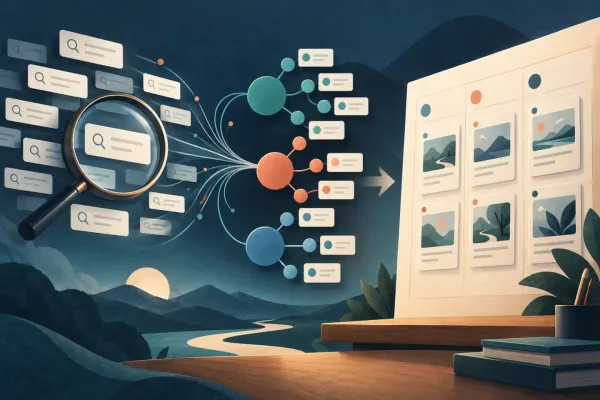
Search Intent Mapping: When Should Queries Share a Page?
Use a five-signal test and a worked SEO audit example to decide when similar search queries belong on one page or need separate URLs.

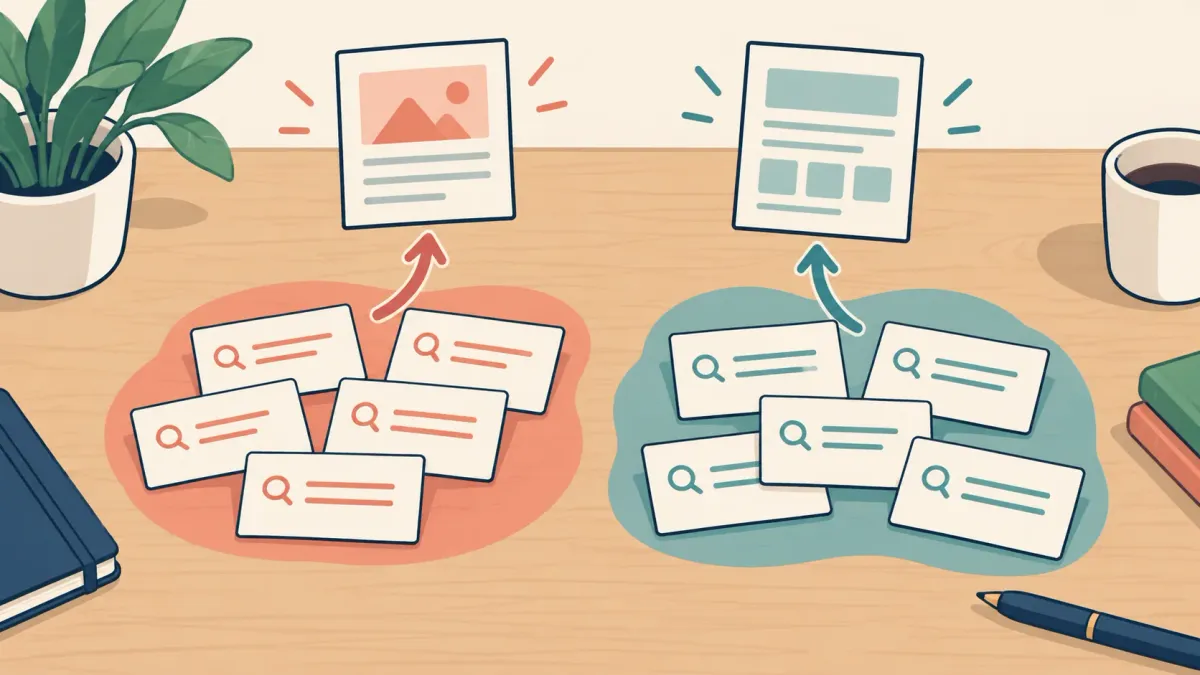
Put two queries on one page when the same reader can complete the same task with the same kind of answer. Make separate pages when the person needs a different outcome, format, or level of detail that would be awkward to bury inside the first page. Similar words are a clue, not the decision.
This is the decision that comes after collecting candidate keywords. Our Search Console content-map guide shows how to find and group queries; here we will test one proposed group before assigning it a URL. The goal is a page that satisfies a real task, not one URL per phrase.
Start with the reader's finish line
Rewrite each query as a sentence beginning “I need to…”. “How to do an SEO audit” could mean I need a process I can follow. “SEO audit checklist” could mean I need a concise list I can use during that process. One well-organized guide might do both. “Technical SEO audit” could mean I need a deeper crawl, indexing, and canonical review. That may need its own page, especially if the general guide would otherwise turn into a technical manual.
The familiar labels informational and commercial are useful but too broad by themselves. Two informational searches may ask for different deliverables. Write the finish line in plain language before looking at volume or average position.
A five-signal test for one page or two
- Same outcome? Can someone who searches either phrase leave with the same decision or completed task? If yes, start with one-page intent.
- Same result format? Compare the current search results for each phrase in the same country and device context. Do tutorials, templates, tools, product pages, or local listings dominate? Similar formats support one page; different formats are a prompt to investigate. There is no magic percentage of shared results that decides for you.
- One clear page promise? Could you write one title and opening answer that honestly serve both searches? A useful section or downloadable worksheet can extend a guide. If the second task needs an entirely different promise, it may deserve its own URL.
- Enough depth without burying the answer? Test a rough outline. If one query's answer would be a short section, keep it together. If each requires substantial examples, tools, or steps and combining them makes navigation harder, split them and link the pages.
- What do existing URLs show? In Search Console, select a query and check the Pages tab to see which URL Google has shown. Then inspect each page. Multiple URLs appearing for one query are a reason to compare their roles, not proof of a “cannibalization penalty.” Google documents this query-to-page view; small sites should also remember that some query rows are omitted.
Use the search results as evidence of what is currently being offered, not as an instruction to copy a competitor. Google's SEO Starter Guide says its systems understand many wording variations and recommends writing with readers in mind. Its people-first guidance asks whether a visitor leaves having learned enough to achieve their goal.
Worked example: an SEO audit cluster
Consider four candidate searches: how to do an SEO audit, SEO audit checklist, SEO audit template, and technical SEO audit checklist. The first two could share a practical general guide: a step-by-step process followed by a concise checklist. That is a hypothesis to validate against current results and the outline, not a claim that Google treats the phrases as identical.
A 9 October 2026 web-results spot check showed a different format cue for SEO audit template: Ahrefs offers files in several downloadable formats. A template may be a useful asset inside a general guide if it serves the same process. If people mainly want to copy or download the file, a dedicated template page with the file, instructions, and a preview may be easier to use.
The same spot check for technical SEO audit checklist surfaced dedicated technical checklists, including a guide focused on diagnosing technical issues. A deeper technical audit has a narrower job than a general website audit. A sensible map might use one general process page, a template asset linked from it, and a separate technical audit page if you can provide enough distinct value. The exact results vary by time, location, and device; repeat the check for your audience before publishing.
Notice what did not drive the decision: a fixed keyword-difficulty threshold, whether two phrases share one word, or a rule that every modifier needs a new URL. The work is to decide which page experience helps each person finish their task.
Use this small mapping note
Copy this for each group before writing a brief:
Queries: …
Reader's finish line: …
Result types checked, date, country, device: …
Existing URL(s) and what they already answer: …
Can one title, opening, and outline serve both? …
Decision: one page / add a section or asset / separate page / defer
What would change my mind? …
For the general-audit example, the first decision could be “one guide for the process and checklist; test whether the template is most useful embedded or on a separate page.” That is specific enough to review later if the page attracts the wrong queries or visitors cannot find the checklist.
If two pages already exist, do not merge by reflex
Read both pages and their query groups. A broad guide and a narrow technical guide can coexist if each has a clear purpose and links to the other where useful. If they are near duplicates that promise the same answer, choose the better destination, preserve important content, and plan the redirect carefully. Google's canonicalization guidance explains how it chooses representative URLs; a canonical tag is not a substitute for making the visitor's path clear.
If the pages are distinct, make that distinction visible in the title, opening, examples, and internal links. If one page is simply underperforming, investigate its query and page data before creating a third. Our Search Console quick-wins guide helps prioritize improvements to existing URLs.
The next step
Take one proposed cluster from your content map, run the five-signal test, and write one sentence explaining why it belongs on one URL or two. Then draft the outline before buying or publishing anything. If the outline keeps requiring a second promise, that is stronger evidence for a separate page than a keyword variation alone.